You bought the gun. You went to the range once, maybe twice. Now it lives in a drawer, and every so often you wonder if you bought the wrong one.
Sometimes the answer is yes. More often the gun was never set up or taught for your hands. Nobody showed you how, and the person at the counter handed you something vague and sent you home.
WGOAA is by women, for women, and this page is for you if you already own a gun. You'll get three checks, two for your kitchen table and one for the range. You'll also get a way to read the results and a plain rule for when to keep the gun and when to change it. If your checks say change, start with Best Handguns for Women (2026): 8 Picks Ranked by Fit or Best 9mm Handgun for Women: 5 Picks That Are Easy to Rack.
Should I keep the gun I already own?
Keep it if it passes all three checks below, or if the one it fails can be fixed with a better grip, a different technique or a different holster. Change it only when it fails on fit or slide effort after you've been shown the technique. A gun that's hard to use because nobody taught you is a training problem, and a new purchase won't solve it.
The standard worth holding yourself to is a plain one. According to American Firearms, "The best handgun for a woman is one she can shoot accurately, handle comfortably, and, if she wishes, conceal easily." That sentence says nothing about brand, color or a label that reads "for women."
How do I check whether a gun fits my hand?
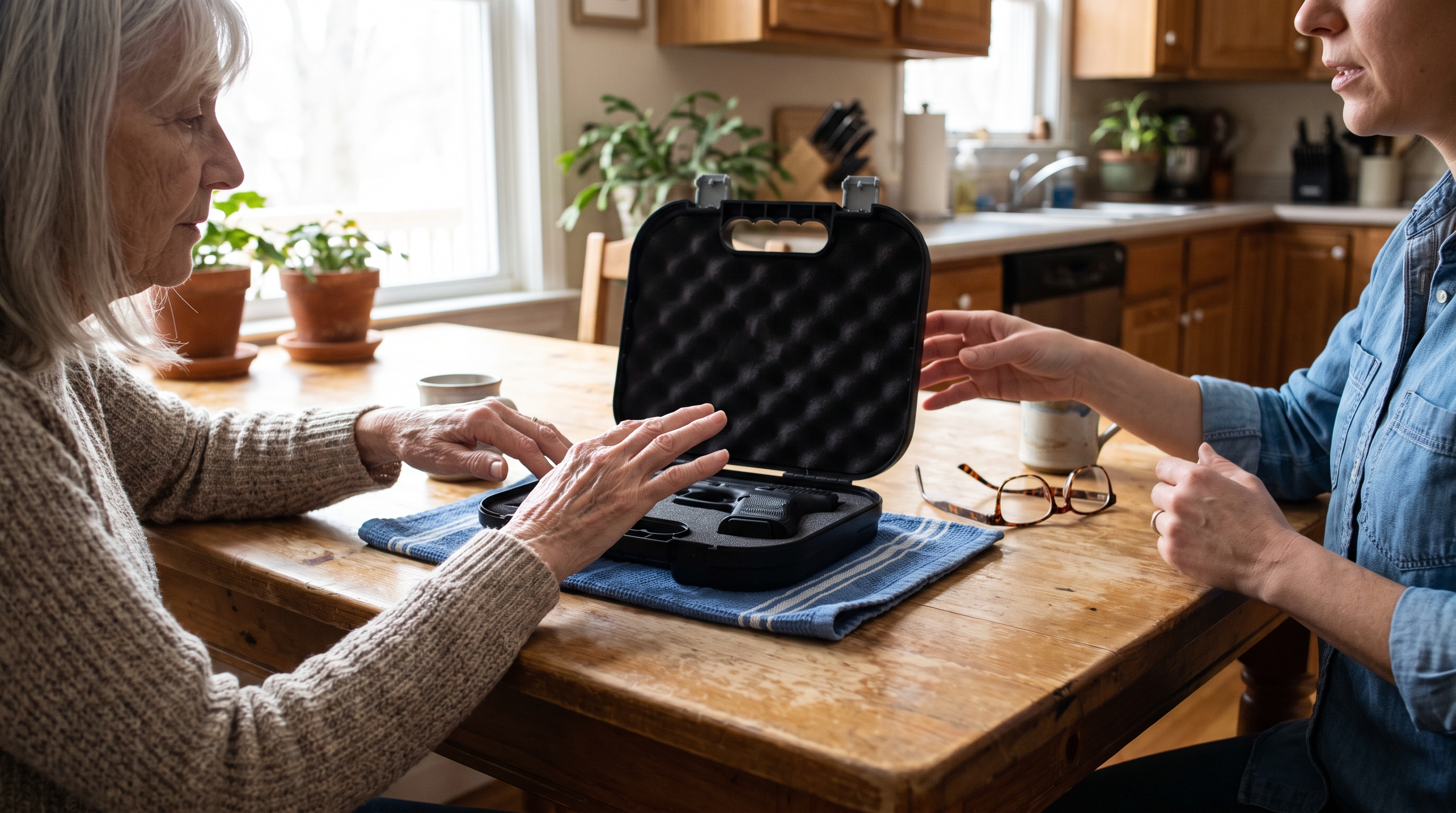
Start by making sure the gun is empty. Take all ammunition out of the room, including loaded magazines and boxes. Remove the magazine, lock the slide back, and check the chamber with your eyes and your finger. Keep the muzzle pointed in a safe direction the whole time, and keep your finger off the trigger until you decide to press it. Sit at a table with good light, and run the checks more than once, because your first grip is rarely your best.
No published measurement tells every woman how far is too far. So judge by what you can repeat with your own hand.
| Check | How to run it | Keep signal | Change signal |
|---|---|---|---|
| Grip reach | At home, unloaded. Take your normal grip. Place the pad of your trigger finger on the trigger without shifting your hand around the frame. | You reach the trigger with the same grip every time, and your hand stays square on the gun. | You have to roll your hand to the side to reach the trigger, or the grip feels like a wide handle you can't close around. |
| Slide effort | At home, unloaded. Rack the slide three times with your technique, then lock it back and release it. | You do it in one smooth motion and keep the muzzle safe. | It takes several tries, your hands shake or hurt, or you have to brace the gun against your body. |
| Recoil control | At the range, with eye and ear protection. Fire a short string with a good grip. | The gun returns to your target without you flinching. | You flinch before the shot, or your hand hurts the next day, even after a grip correction. |
If the gun fails the first row, you have a fit problem. If it fails the second, you may have a technique problem or a fit problem, and the next section helps you tell which. If it fails the third, get a second opinion at the range before you decide anything.
How much slide effort is too much?
It's too much when you still can't cycle the slide smoothly after you've learned a leverage-based method. A lot of women fail this check because they were taught to pull the slide back with a clenched fist and arm strength. That punishes smaller hands and older hands. WGOAA teaches Technique, Not Strength, and the push-pull technique uses body mechanics and leverage instead of grip strength.
In practice, the hand holding the gun pushes the frame forward while the other hand draws the slide back. One hand doesn't do the whole job. Learn it with an unloaded gun at home, where nobody is watching.
If the slide check fails, Safe Start LIVE is a good place to begin. It's a two-hour live beginner class for $27, and the replay is included. Our guide to the best guns for women with weak grip or arthritis shows what easier-racking pistols look like. If you've learned the method and the slide still fights you, the spring is working against your hands. That's a fair reason to change guns.
Does heavy recoil mean I have the wrong gun?
Not always. Recoil that bothers you often comes from a loose grip, a hand riding too low on the frame, or a stance that leans back. Fix those first. If you still flinch after a grip correction, the gun may be too small or too light for your hand, and a rental will tell you. The smallest gun on the shelf isn't automatically the one that feels best.
When should I change the gun instead of fixing my technique?
Change it when the problem survives the fix. Run the checks, get a grip and slide-method correction, then run them again. This table turns what you find into a decision.
| After retesting | What it means | What to do |
|---|---|---|
| Fails grip reach again | The frame is too large for your hand | Try other frames before you buy |
| Fails slide effort again, with good technique | The spring is too stiff for your hands | Look at easier-racking models |
| Fails recoil only | Grip, stance or size is off | Get a coach to watch you shoot, then rent a different size |
| Passes all three | The gun is fine | Keep it and build practice time |
| Passes, but you never carry it | The holster or the clothing is wrong | Fix the carry setup, not the gun |
The last row matters more than it looks. Plenty of women own a gun that works and never carry it, because the holster shifts or prints. Our guides to the best IWB holster for women and the belly band holster take that problem on directly.
How can I try other guns without buying one?
For live fire near you, the WGOAA National Directory lists women-friendly instructors and ranges. Bring your checklist, and write down your results for each gun, not just which one felt nicest.
Renting is the other route. One forum member on the SBG Sword Forum gave the standard advice: "Ideally though, go to a range that rents pistols guns and shoot as many different ones as you can until you find the one that suits you most." A rental costs little next to a purchase you regret.
An organized comparison works too. NRA Women described a pistol event with "47 women firing a selection of .380 ACP caliber and 9mm semi-automatic pistols." You don't need an event that size. A friend with a different model, or an instructor with a few frames on hand, gives you the same side-by-side feel.
What mistakes make women choose the wrong gun?
Most wrong choices come from deciding too fast or trusting the wrong signal. The first is buying for size alone. A smaller gun is easier to hide, but it can be harder to hold and sharper in recoil.
The second is trusting the label. A gun sold to women hasn't been fitted to your hand, and you only learn fit by holding the gun.
The third is blaming your hands. If you can't rack the slide, suspect the method you were taught first and the spring second.
Then there's skipping training because you changed guns. A new gun doesn't give you a skill you never learned. As one forum member on the Shooters Forum wrote, "Effective home defense does not begin and end with a firearm."
Last, letting someone else choose. A husband's favorite or a clerk's upsell reflects their hand and their habits, not yours.
If you want fit explained in depth, the Academy's course Picking The Right Gun For You is taught by Lisa "Guns" Ludwig. You can see what's inside on the Armed Female Academy page.
FAQ
What is the most popular gun for women?
We found no reliable ranking in the sources we checked, so we won't name one. Popularity only tells you what other people bought. Your hand is the test that matters. For model picks, read Best Handguns for Women (2026).
What is the best caliber for a woman to shoot?
The one you can control and practice with. American Firearms says "If you intend to carry it someday, 9mm is an excellent caliber, as it's likely what you'll carry." Rent one first and check the recoil before you commit.
Is a 380 or 9mm better for a woman?
Neither wins for everyone. Both calibers were fired side by side at the NRA Women event above. Compare a .380 and a 9mm of similar size on your own slide effort and recoil checks, and keep the one that passes.
How do most women conceal carry?
We found no sourced figure for the most common method, so we won't guess. Women carry in holsters, belly bands and off-body bags, and the right one depends on your body and your clothes. Start with our belly band guide.
What should I do today?
Tonight, take your gun to the kitchen table. Take all ammunition out of the room, confirm the gun is unloaded, and run the first two checks, grip reach and slide effort. Write each result on paper as keep or change. Save the recoil check for your next range visit, with eye and ear protection on. If two or more rows say change, read Best Handguns for Women (2026). If every row says keep, book one range session to practice what you learned.
Training does not guarantee any specific outcome in a defensive situation. Online training is not a substitute for hands-on, in-person instruction with a qualified instructor. Always follow all applicable federal, state, and local firearms laws. WGOAA does not provide legal advice; consult a licensed attorney in your state regarding concealed carry and self-defense law.
Always treat every firearm as if it is loaded, keep your finger off the trigger until you are ready to fire, and never point a firearm at anything you are not willing to destroy.