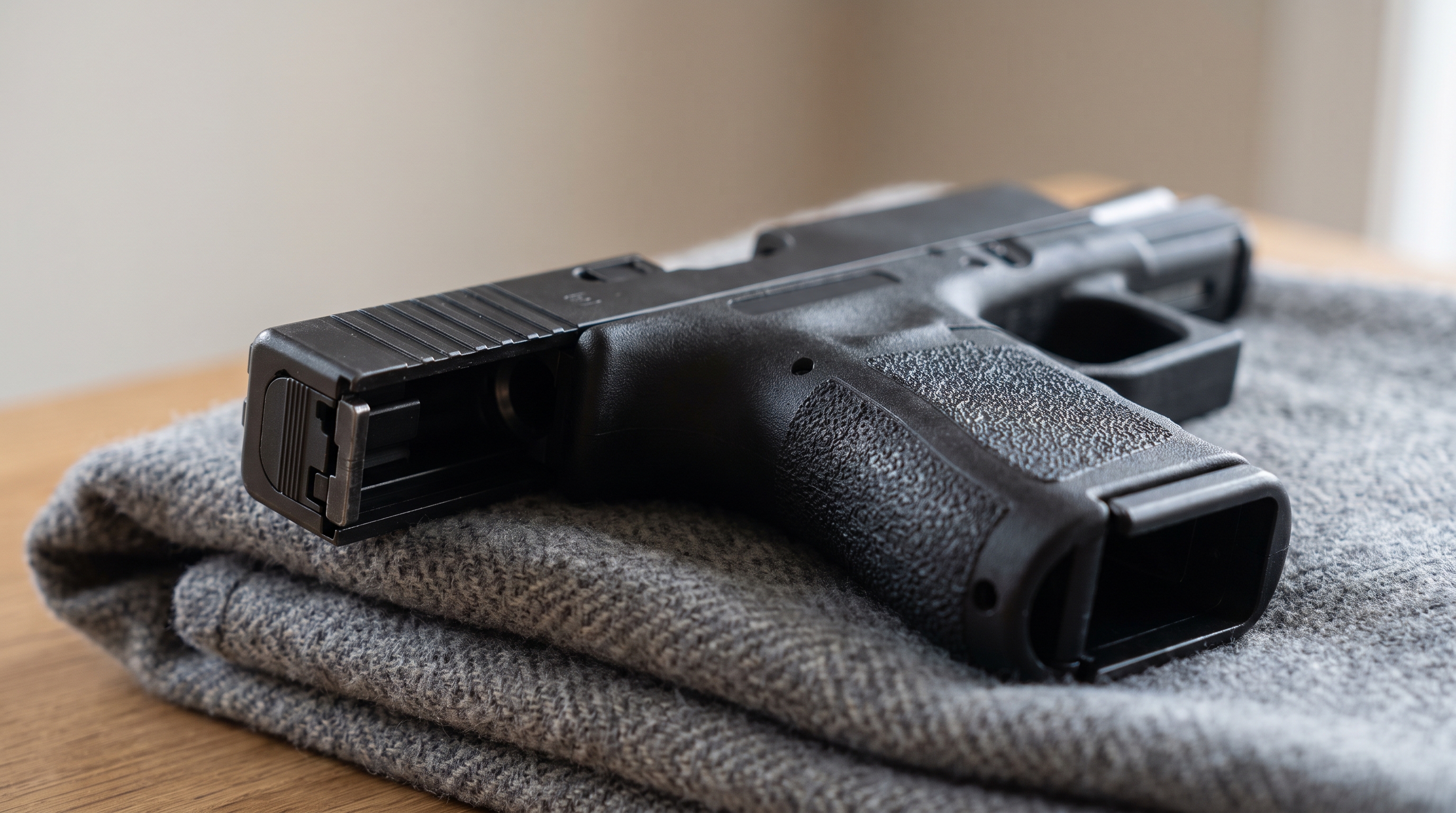
This guide is written for the woman who already owns a handgun and doesn't feel competent with it. Maybe you bought it after a scare, went to the range once or twice, struggled with the slide while someone watched, and put it away. "Firearms" here means handguns, because that is what most of the women we teach already own. The gun you carry every day is the one that has to pass these tests.
WGOAA is by women, for women. I'm Amara Barnes, founder of WGOAA, and I'm a 911 dispatcher. I heard the calls that came in too late, and I decided to buy a gun. I searched "Women Gun Owners Association" and found nothing built for women. I sat in the gun store parking lot working up my nerve. Then I walked in and was talked down to.
Why does the gun in my drawer feel wrong?
Usually because it was chosen for someone else's hands, or chosen in a hurry at a counter. It is rarely your strength, your age or your nerve. Many women are handed whatever a salesperson likes, then taught by a person who never had to solve the same problem.
Any list of "best" guns is only a starting point. Your hand is the test.
This page gives you the tests.
What should a woman look for in a firearm?
Look for three things, in this order: how it sits in your hand, how easily you can rack the slide, and how it feels to shoot. Caliber, brand and price come after those. If a gun fails the first three, the rest does not matter, because you will not practice with it.
| Test | What you check | Passes when | Where it comes from |
|---|---|---|---|
| Hand fit | Grip, trigger reach, controls | Your whole hand sits comfortably and your finger reaches the trigger without stretching | Your own hand, in person |
| Slide ease | Racking with a sound technique | You rack it smoothly, without a pinch grip, in one try | Technique, practiced at home |
| Recoil | How it feels over a full range session | You are still comfortable and want to keep shooting | A rental or a borrowed gun |
Do these three tests before you read a single review. Reviews can tell you what a gun weighs. They cannot tell you what it does in your hand.
How do I know a gun fits my hand?
A gun fits when you can wrap your hand fully around the grip, reach the trigger with the pad of your finger and operate the controls without shifting your grip. Fit is physical and personal. Two women with the same glove size can prefer different guns.
A few practical checks:
- Hold the unloaded gun and confirm it is unloaded before anything else.
- Check that you can reach the magazine release without letting go of the gun.
- Check that the trigger finger rests naturally and the muzzle stays pointed in a safe direction.
To try guns in person, the WGOAA National Directory lists women-friendly instructors and ranges.
Small controls matter more than most buyers expect. A gun can be a good match for you and still have one control worth changing.
Can I rack the slide if my hands are weak or arthritic?
Yes, for most women, because racking a slide is mostly technique. Strength plays a smaller part. This is the heart of the Technique, Not Strength method we teach, and the push-pull technique is its clearest example.
Here is the push-pull idea in plain terms. Grip the slide with your support hand and keep that hand still. Push the gun forward with your firing hand, using your arm and body rather than a pinch of your fingers. The slide moves back relative to the gun, and you never have to out-muscle the spring.
Changing the grip changes the result. Members tell us the same thing. One wrote in a Facebook ad comment on 2026-07-03: "Now I can rack it back and I'm 65 years old!"
If you have arthritis or a weak grip, read our guide to the best guns for women with weak grip or arthritis. It covers models built to be easier to operate.
Practice the motion at home with an unloaded gun, in good light, and with every safety rule in place. Our guide to dry fire training for women shows how to build the reps without anyone watching.
How much recoil is too much?
Recoil is too much when it makes you flinch, tense up or stop shooting before you have learned anything. Size alone won't tell you. A small gun that is easy to carry can still be unpleasant to practice with.
So test it. Rent the gun, if your range offers rentals, or borrow one, and shoot it for twenty minutes. Ask whether the recoil lets you keep your sights on the target and whether you want to keep going.
Skill comes from practice, so comfort at the range counts for as much as comfort in a holster. Treat any recoil number you see without a named test method with caution.
Does trigger weight matter?
Yes. Trigger weight is how much pressure it takes to fire the gun. A heavy trigger is hard on a weak hand and makes accurate shooting harder. It varies widely from gun to gun, so check it in person rather than assuming.
Press the trigger on an unloaded gun, with the muzzle in a safe direction. Ask whether you can do it smoothly, without your whole hand tightening.
Are revolvers easier for women?
Not necessarily. A revolver has no slide to rack, which some women value. But a small, light one can be a poor first choice, and a tiny revolver is a common recommendation that does not always serve a new shooter well.
A longer barrel and a bigger frame can change the experience. Rent a few sizes if your range offers rentals, and see how each one feels to you.
If you own a revolver, you are not behind. Our courses are taught on semi-automatics, and grip, stance, sight alignment and trigger control carry over to any handgun. Magazine loading and slide work do not.
Does a bigger gun shoot better?
Often, yes. A longer barrel gives a longer sight radius, which is the distance between your front and rear sights. More distance makes it easier to line them up. A larger frame also gives your hands more to hold. The tradeoff is concealment, so you weigh accuracy against how much gun you will actually carry.
Capacity, the number of rounds a gun holds, is a third thing to weigh. Check it on the specific model you are considering, since it varies from gun to gun.
What about a smaller caliber?
Some women choose a .22 because it is easy to shoot. That is a real tradeoff.
The right caliber is the one you can shoot accurately, calmly and reliably. A caliber that frightens you into a flinch is the wrong one for you, whatever the chart says.
Where do specific models fit?
Read them for the hand-fit and slide notes, then test the gun yourself.
- SIG Sauer P365 review for women
- Walther PDP-F review
- Smith & Wesson M&P Shield review for women
- Ruger LCP MAX review for women
- Best 9mm handgun for women: 5 picks that are easy to rack
For a ranked overview, see Best Handguns for Women (2026): 8 Picks Ranked by Fit. Once you have a gun, the holster decides whether you carry it, which is why we also wrote about the best IWB holster for women.
What are the common mistakes?
Most bad buys come from skipping the three tests. These are the patterns we see most often.
- Buying the smallest gun available. Small guns can be harder to hold and harder to shoot well.
- Trusting the counter. A salesperson may steer you to a small revolver or a gun they like. Use your hands as the judge.
- Never racking the slide before buying. If you cannot do it with good technique, ask to be shown before you pay.
- Picking by caliber chart. A number on a chart does not tell you whether you can control the gun.
- Skipping practice because the gun is uncomfortable. If you dread the range, the gun is the problem. Change the gun, or the setup, before you quit.
- Assuming the law is the same everywhere. Concealed carry rules differ by state and change often. Confirm current rules with official state sources or a licensed attorney.
FAQ
Is a .380 or 9mm better for a woman?
Neither is better for every woman. The better one is the one you can shoot accurately, control calmly and feed reliably. Test both in person and choose by comfort and accuracy.
What is the number one concealed carry pistol?
No single pistol is number one for everyone. The pistol worth carrying fits your hand, racks without a fight and is one you will practice with.
What if the gun I already own doesn't fit?
You have not wasted your money. Find which of the three tests it fails: reach, slide or trigger. A different grip technique, a small control change or a different gun may solve it. Test before you buy again.
Can I learn to rack a slide at home?
Yes. Practice the push-pull motion with an unloaded gun after confirming it is unloaded. Our Armed Female Academy teaches the technique step by step, taught entirely by women, with lifetime replay.
What should I do today?
Take your own gun out of the drawer, confirm it is unloaded, and run the three tests above. Notice where it fails: reach, slide or trigger. Write that down. It will tell you what to look for in the next gun, or what to change on this one. When you are ready for help choosing, Lisa "Guns" Ludwig teaches Picking The Right Gun For You inside the Armed Female Academy.
WGOAA and the Armed Female Academy provide firearms education for informational purposes only. Training does not guarantee any specific outcome in a defensive situation. Online training is not a substitute for hands-on, in-person instruction with a qualified instructor. Always follow all applicable federal, state, and local firearms laws. WGOAA does not provide legal advice; consult a licensed attorney in your state regarding concealed carry and self-defense law.
Always treat every firearm as if it is loaded, keep your finger off the trigger until you are ready to fire, and never point a firearm at anything you are not willing to destroy.
State law or reciprocity: confirm current law with official state sources or a licensed attorney before relying on it.