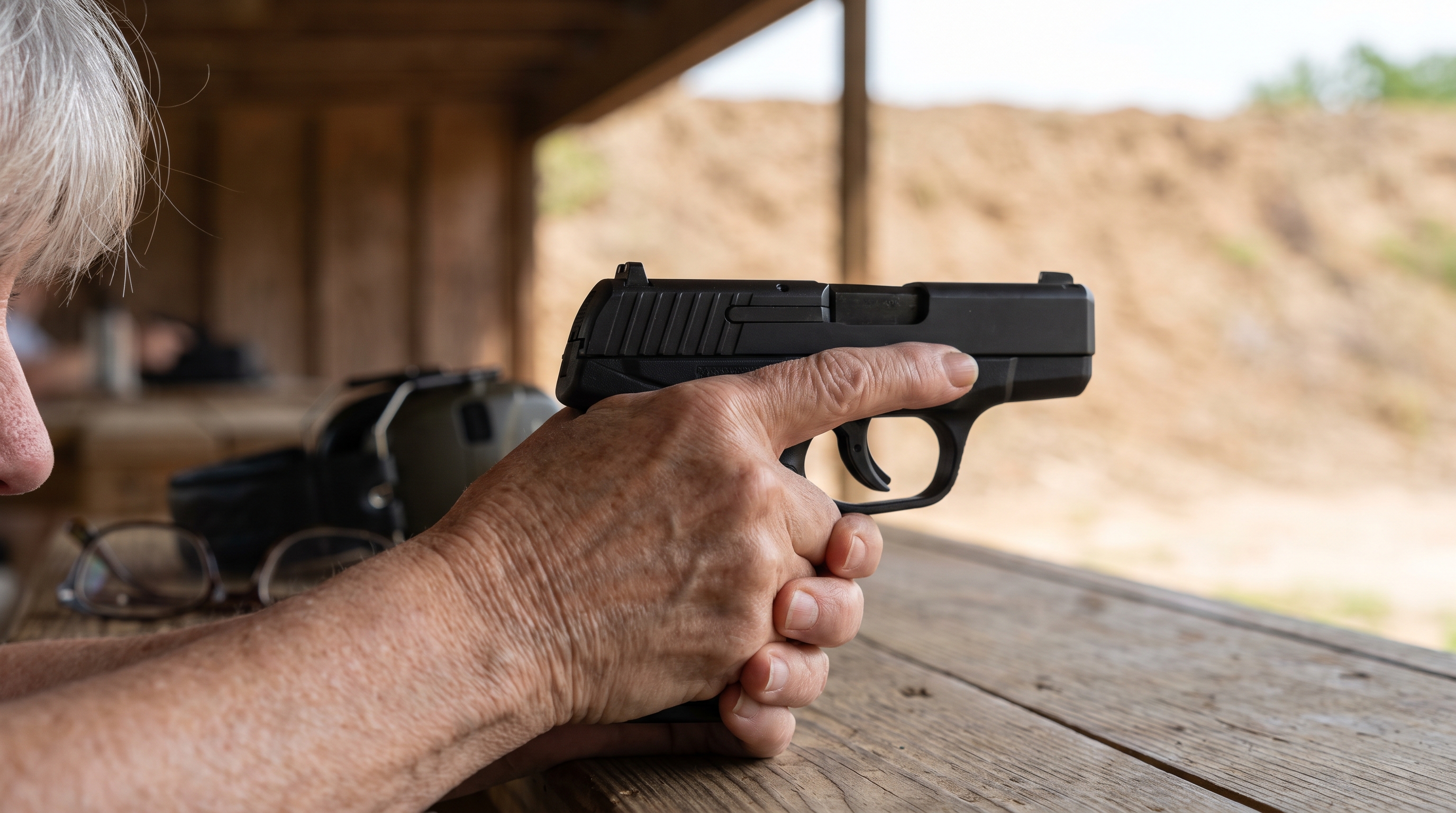
The best gun for a woman is the one that fits her hand. We check three things in order, starting with whether your finger reaches the trigger without shifting your grip, then whether you can rack the slide easily, then whether the recoil lets you keep your sights. A gun that fails one isn't the one.
Why does a "best gun for women" list rarely answer the question?
A list tells you what other people bought. It can't tell you what your hand can reach, whether the slide moves for you, or how the gun feels on the fortieth shot of an afternoon at the range. Popularity measures sales.
At a 2024 national training conference, 706 women brought 976 handguns. NRA Women reported the brand split as "Glock 22.75% Sig Sauer 20.29% Walther 17.01% Smith & Wesson 9.63%." Those women were already training together, and they still spread across at least ten brands. If one gun fit every woman, the list would have one line.
This piece is for the woman who already owns a handgun and doesn't feel competent with it. We're a women-only education community, by women, for women, and we start from one belief: nobody ever showed you how to choose a gun built around your hand. Maybe yours lives in a drawer. Maybe you rack the slide in three tries while someone watches. Maybe you're about to buy a second gun because the first never felt right. Start by asking whether the gun was ever fitted to you, because most women were simply handed something and told to practice.
This page goes one step earlier. It gives you the tests that decide which of those picks, or any other gun, belongs in your hand.
What does "fit" actually mean on a handgun?
Fit means three checks. They come in a fixed order, and a gun that fails the first one doesn't earn a second look, however good its reviews are or however many of your friends carry it.
| Order | Criterion | The test | Passes when | Disqualifies when |
|---|---|---|---|---|
| 1 | Grip and trigger reach | Wrap your dominant hand around the grip, then place your finger on the trigger with the gun unloaded and pointed in a safe direction | Your finger reaches the trigger without shifting your whole hand | You have to rotate the gun in your palm to get the trigger |
| 2 | Slide racking | Rack the slide at the counter, five times, with the dealer's help clearing the gun | The first and fifth pull feel about the same | You're fatiguing by the third pull, or it takes a second try |
| 3 | Recoil | Rent the gun and fire it for twenty minutes | You can keep your grip and see your sights after each shot | You start anticipating the shot and flinching |
Grip comes first because trigger reach can only be adjusted within limits. Springs, sights and triggers can sometimes be changed too, but past those limits the distance from your palm to the trigger stays what it is.
How do I test grip and trigger reach?
Wrap your hand around the grip and see whether your finger lands on the trigger without your hand shifting. Fit before brand is the rule. If the reach is a stretch, move on to the next gun.
Two habits make the grip test more honest:
- Hold the gun the way you'd actually hold it to shoot, with both hands, not the way it looks best in a photo.
- Check your thumb and your support hand too. A grip that's too thick for your fingers often leaves the support hand with nowhere to go.
If you've owned your current gun for a while, the grip may be fine and the problem may be technique. Grip, stance and trigger control are teachable skills, and our guide to dry fire training for women shows how to practice them at home. Test the fit first, then decide whether you need a different gun or different instruction.
Why can't I rack the slide, and is it my fault?
It isn't your fault. Racking trouble usually comes from the gun's spring weight, the texture of the slide and your technique, and we teach it as a question of fit and method, never a flaw in you.
To separate a gun problem from a technique problem, work through four steps:
- Ask the dealer to clear and safe the firearm. Always treat every firearm as if it is loaded.
- Rack the slide five times in a row. Watch what happens on pull number five.
- Try again using the push-pull method, where the gun hand pushes forward as the other hand pulls back. It uses body mechanics and leverage rather than grip strength.
- If the gun still fights you after that, it doesn't fit. Cross it off.
That last step matters for women who've been told to just try harder. A carry gun may be racked cold, under stress, possibly with one hand, so if it takes effort in a quiet store, it's the wrong gun for that job.
Technique changes the answer more often than you'd expect. Our guide on guns for women with weak grip or arthritis goes deeper on easy-rack options.
There's also a mechanical alternative. According to American Gun Owners, "Many first-time owners find a slim single-stack 9mm, a .22 pistol, or a .38 revolver easy to operate, and a revolver has no slide to rack at all." Choosing a revolver is a legitimate answer to a racking problem.
WGOAA's hands-on handgun courses are taught on semi-automatics. Grip, stance, sight alignment and trigger control carry over to any handgun, but if you choose a revolver, expect to adapt some of the slide-handling lessons.
Is a 9mm too much gun for a small-framed woman?
Not necessarily. Whether a caliber is too much depends on how the gun feels in your hand over twenty minutes of shooting, and only a rental will tell you that.
The .380 versus 9mm question has a short answer. American Gun Owners notes that "A 9mm is more versatile and has more training and ammunition options, while a .380 usually has lighter recoil in a smaller, simpler gun." Both are reasonable. The right one is the one you can shoot for twenty minutes without flinching.
| Type | What it tends to do well | What to watch for |
|---|---|---|
| 9mm | More versatile, with more training and ammunition options | Rent it and see how the recoil feels to you |
| Slim single-stack 9mm | Thin profile, one of the easier types for first-time owners to operate | Check trigger reach and slide effort yourself |
| .380 | Usually lighter recoil in a smaller, simpler gun | Confirm you can rack it and hold it comfortably |
| .22 pistol | A common choice for practice | A training tool first |
| .38 revolver | No slide to rack | Hands-on courses use semi-autos |
The .22 deserves a mention. If you own a gun you flinch from, a .22 may be the fastest way to rebuild your trigger control without recoil in the way.
Which guns do women actually start on?
One instructor writing for SOFREP starts new shooters on a mid-size 9mm, the Glock 19. In that SOFREP piece, the author wrote: "As I've said before, I always start new shooters on a Glock 19." That's one instructor's habit, a useful signal and nothing more. Weight, slide stiffness and grip shape all vary, and a gun that's popular with instructors can still fail your first test.
If you want a full evaluation of a specific model through the same fit lens, start with one of these:
- Glock 43X Review for Women
- Walther PDP-F Review
- SIG Sauer P365 Review for Women
- Smith & Wesson M&P Shield Review for Women
- Ruger LCP MAX Review for Women
Read them after you've run the three tests, not before. Otherwise a review tells you what to want, and your hand hasn't been consulted yet.
How do I test a gun before I buy it?
Rent first, then buy, if your range offers rentals. Twenty minutes of shooting tells you more about a gun than another review will.
At the counter and the range, the order that works looks like this:
- Check grip and trigger reach with the gun cleared.
- Rack the slide five times.
- Load a magazine by hand and notice how your thumbs respond.
- Rent the same model and fire it.
- Match the gun to how you'll carry it. Deep concealment, a purse, a bedside table and a range bag can point to different guns. Our IWB holster guide covers the carry side.
If you have a qualified instructor, bring her. She can read your grip in real time and give you an honest answer.
What are the common mistakes when choosing a gun?
These are the ones that send a gun back to the drawer:
- Buying the gun someone else picked. A gun chosen without your hand in it is a guess.
- Choosing the smallest gun for concealment. Tiny guns can be harder to hold and more painful to shoot, so they stay home.
- Skipping the rack test. If you can't do it easily at the counter, you won't do it under stress.
- Reading your struggle as a personal verdict. Struggling with a gun that doesn't fit is a fit result, not a verdict on your hands, strength or age.
- Buying on brand loyalty. Brand tells you about the maker. Fit tells you about you.
- Skipping training after the purchase. The gun is the smallest part of being prepared. Skill is the rest.
If you're unsure whether you're ready to carry at all, Am I Ready to Carry a Gun? is a calm self-assessment, and Your First 30 Days of Carrying lays out what comes next.
Frequently asked questions
Is a .380 or 9mm better for a woman?
Neither wins for everyone. Let your hands decide: whichever one you can rack easily and shoot for twenty minutes without flinching is better for you. Rent both before you buy.
What is the best gun for a woman with small hands?
The one whose trigger your finger reaches without shifting your grip. Hand shape matters as much as hand size, so hold several models before deciding.
Do I need training once I've picked a gun?
Yes. Fit gets the right gun into your hand, and training is what makes it yours. Safe Start is our live beginner class for women, and the Armed Female Academy goes deeper on handling, carry, law and trauma care.
What should I do today?
Pick one gun you already own or want to buy. Take it to a counter or range that will let you handle it, and run the three tests in order: grip reach, five slide racks, then a rental fire if the first two pass. Write down which test it failed. That one line will tell you whether you need a different gun, a different technique, or just practice.
If you want structured help once you have the right gun, the Armed Female Academy teaches handling, fit, carry, law and trauma care from women instructors, and membership adds live monthly training.
Online training is not a substitute for hands-on, in-person instruction with a qualified instructor. Always follow all applicable federal, state, and local firearms laws. WGOAA does not provide legal advice; consult a licensed attorney in your state regarding concealed carry and self-defense law.
Always treat every firearm as if it is loaded, keep your finger off the trigger until you are ready to fire, and never point a firearm at anything you are not willing to destroy.