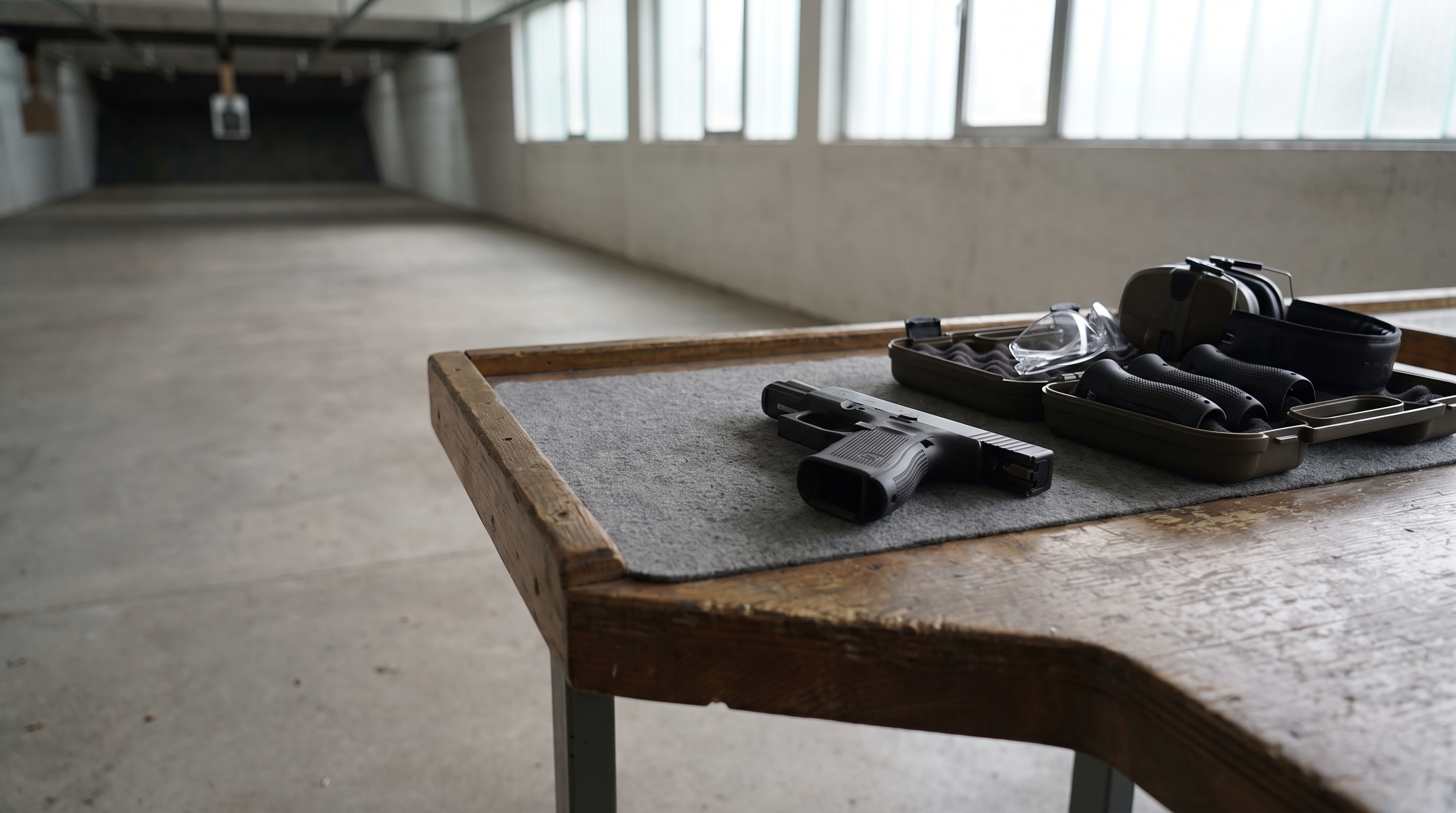
The best handgun for a woman is one she can shoot accurately, handle comfortably and, if she wishes, conceal easily, according to American Firearms. If yours fails one of the five tests below, you don't necessarily need a new one. Test it, adjust the fit, and swap only when adjustments fail.
Why are you second-guessing the gun you already own?
Something about it has felt wrong since the day you bought it. Maybe the slide takes three tries while someone watches. Maybe it lives in a drawer, a bag or a safe because it never felt like yours. Maybe the person at the counter handed you something vague and you didn't know enough to push back. That's common.
Women are not a niche in this world. A 2021 survey designed by Harvard and Northeastern researchers suggests that 46.6% of new gun owners since January 2019 were women, and Shooting Illustrated reports that about a third of sport shooters in 2022 were female. Yet most firearms training was built around a man's hands and a man's patience, then offered to women as it was. That's why WGOAA exists: training by women, for women. Your hesitation is information about fit and about how you were taught. It isn't a verdict on you.
Most advice on this topic is written for a woman standing in the shop with cash in her hand. This guide is for the woman who has already bought, and who wants to know whether the gun is the problem or whether she is. For the shopping version, read our ranked list of best handguns for women.
One member described what changed for her: "I got over the fear of handling a gun! I gained knowledge of how it works and also, the confidence to handle it!" (Barbara O.)
Student testimonials reflect individual experiences and are not a guarantee of similar results.
What makes a handgun the right one for a woman?
Operate it, hold it steadily, shoot it accurately and carry it consistently. That matches how American Firearms puts it: the best handgun for a woman is one she can shoot accurately, handle comfortably and, if she wishes, conceal easily.
There's no brand, caliber or price in that definition. An instructor-run guide from Emmaus Defense boils the central question down to whether the gun actually fits your hand and strength. A gun that fits and is plain beats a gun that is famous and fights you.
How do you test the handgun you already own?
Run five checks at your kitchen table, with the ammunition in another room. Start by removing the magazine, locking the slide back and looking into the chamber to confirm it's empty. Everything below is a dry check with an empty gun.
- The rack test. Rack the slide five times in a row without stopping. Note whether the fifth pull is as clean as the first. If you need to brace the gun against your body, or your hands shake after three tries, write that down.
- The grip test. Hold the gun with a firm two-handed grip and look at where your fingers land. Your pinky shouldn't dangle in the air with nothing under it, and the backstrap should sit high in the web of your hand.
- The reach test. Hold the gun the way you would to shoot, with your finger resting along the frame, outside the trigger guard. Then slide your finger onto the trigger and see whether you have to shift the gun in your hand to reach it. If you do, the grip is too big for you.
- The shooting test. At the range, fire a few magazines at a close target and watch for flinching, sore web skin and groups that drift. If you wince before you press, the recoil is part of the answer.
- The carry test. Wear the unloaded gun in its holster at home for a full day, in what you actually wear. If you take it off by noon, the gun may be fine and the carry setup wrong.
A gun that fails once isn't condemned. Where it fails tells you what to change.
Should you keep it, adjust it or swap it?
The rule of thumb is simple. Keep it if it passes four of the five tests, adjust it if the failures are about fit, and swap it only if they're about the design of the gun itself. The table pairs each result with the first thing to try.
| What you noticed | Likely cause | First move | Swap if |
|---|---|---|---|
| Slide takes several tries | Technique, spring weight or both | Learn the push-pull method, then retest | It still takes effort after you have practiced |
| Pinky dangles | Magazine too short for your hand | Try an extended magazine or a pinky-extension base pad | No available magazine fills the grip |
| Trigger reach feels long | Grip circumference too large | Try a different backstrap or grip module if the model offers one | The model offers no smaller option |
| Recoil makes you flinch | Gun too light, grip too loose, or load too hot | Fix the grip first, then try lighter loads | It still hurts after your grip is corrected |
| Takes the gun off by noon | Holster, belt or wardrobe mismatch | Change holster position or style | No setup disappears under your real clothes |
| Feels fine at home, worse at the range | Nerves and no practice | Dry fire at home, then return | It still feels wrong after months of practice |
Adjustments cost far less than a new gun, so start in the third column.
Can a rack problem be fixed without a different gun?
Often, because racking is mostly technique. Your hands don't have to overpower the spring. Pushing the gun forward with your shooting hand while pulling the slide back with the other uses leverage and body position instead of grip strength. Our Armed Female Academy teaches this as the Push-Pull Technique, and it's the reason we say technique, not strength. That holds at 65 or 75, and it holds with sore joints.
Spring weight does matter, though, especially if you have arthritis or a weak grip. Our published review of the Walther PDP-F puts the cut in slide effort at about 20% compared with standard semi-automatics. That figure comes from our own review, not from a manufacturer's measurement, so check Walther's published specs before you rely on it. If you've practiced the technique for several weeks and the slide still fights you, that's the moment to think about a swap. Our guide to guns for weak grip or arthritis is the next page to read.
Can a small change to the grip save a gun you almost sold?
Yes, and magazine length is the cheapest example. The Sig Sauer P365 comes standard with a 10-round magazine, with options to extend up to 12 or 15 rounds. In our SIG P365 review, we say the 12-round extended magazine adds about half an inch of grip and, for the majority of women we train, transforms the gun. One small part changed how the whole pistol behaved.
Before you decide a gun is wrong, ask whether a magazine, a base pad, a backstrap or a different holster would fix the one thing that bothers you. Buy the part only after you've confirmed it fits your exact model.
Is a .22, a .380 or a 9mm the right caliber for you?
Pick the caliber you can shoot accurately and will practice with. Smaller calibers recoil less. Larger ones carry more power and more push. Neither is automatically correct.
One common piece of advice deserves care. American Firearms calls it a myth that all women should learn to shoot on a .22 LR, while allowing that if reduced hand strength warrants it, something is better than nothing. The same source says that if you intend to carry someday, 9mm is an excellent caliber, as it's likely what you'll carry.
If you flinch on a 9mm, don't assume you have to give up the caliber. Fix your grip, try a heavier gun or a softer load, and see whether the flinch goes away. If it doesn't, a .380 is a reasonable step, and the choice is yours.
When is swapping the right call?
Swap when the failure is built into the gun and no adjustment reaches it. Three situations qualify.
- The gun is too large for your hand even with every available grip option, so you can't reach the trigger or hold it steady.
- The slide or trigger takes more effort than your hands can supply after real practice with the correct technique.
- You can't find a carry setup that works with the clothes you wear most days.
If you do swap, take the lessons with you. Write down what failed and bring that list to the counter. Ask to handle the gun, rack it ten times, and hold it for a full minute before you pay. A good shop lets you. The Armed Female Academy includes a course built for this exact question, Picking The Right Gun For You, taught by Lisa "Guns" Ludwig, a certified armorer and NRA-certified instructor (her credentials are her own, not WGOAA's). Our reviews of the Smith & Wesson M&P Shield, the Glock 43X and the Walther PDP-F go through each model in detail.
Common mistakes when deciding whether to keep a handgun
- Blaming yourself. If the slide fights you, the cause is more often the gun's design or your technique than your hands. Nobody showed you how.
- Swapping before practicing. A new gun carries new problems, and you won't know which are the gun and which are you if you've never trained.
- Buying on someone else's recommendation. A friend's favorite was chosen for a different hand and a different wardrobe.
- Skipping the carry test. A gun that works at the range but doesn't fit into your day will end up in a drawer again.
- Judging the gun on one bad range visit. Nerves and a watching crowd change everything. Dry fire at home first.
Building a home practice is the cheapest fix of all. Our guide to dry fire training for women shows how.
FAQ
Is a .380 or 9mm better for a woman?
Neither wins for everyone. A .380 recoils less, which helps if recoil makes you flinch. A 9mm gives you more power and far more models to choose from. Pick the one you can shoot accurately and will practice with, and test both if you can before buying.
Am I too old to learn to handle my gun properly?
No. There's no age limit, and most of WGOAA's audience is over 60. Handling comes down to technique, not strength. The push-pull method and a gun that fits your hands get most women there, including women with arthritis or an old injury.
I have a revolver. Does this still apply?
Mostly, yes. Our hands-on handgun courses are taught on semi-automatics, but grip, stance, sight alignment and trigger control carry over to any handgun. The grip, reach, shooting and carry tests work the same way. Only the rack test doesn't apply.
Do I need to replace my gun if the slide is hard to rack?
Not necessarily. Try the push-pull technique and practice for several weeks first. If the effort stays too high, look at models designed to cut slide effort, and handle them in a shop before you buy.
What to do today
WGOAA and the Armed Female Academy provide firearms education for informational purposes only. Training does not guarantee any specific outcome in a defensive situation. Online training is not a substitute for hands-on, in-person instruction with a qualified instructor. Always follow all applicable federal, state, and local firearms laws. WGOAA does not provide legal advice; consult a licensed attorney in your state regarding concealed carry and self-defense law.