Let's not sugarcoat this.
Finding a firearms instructor for women shouldn't feel like a hostile job interview — but for most women, it does. You walk in ready to learn, and within five minutes you can tell: this class wasn't designed for you. The pace is wrong. The tone is wrong. The instructor talks at you instead of to you. And by the end, you leave knowing less about your gun and more about how invisible you felt in that room.
That's not training. That's a waste of your time and money.
Only 8% of firearms instructors in America are women. Which means 92% of the people teaching you how to defend your life have never carried concealed in a sundress, racked a slide with freshly manicured nails, or tried to draw from a holster while holding a toddler's hand.
That doesn't mean a male instructor can't train you well. It means you need to know what separates a good firearms instructor from one who's going to set you back — or worse, make you quit entirely.
Here's exactly what to look for.
1. They Teach You — Not Perform for You
The biggest red flag in women's firearms training is an instructor who spends more time showing off than teaching. You know the type — they rapid-fire a magazine into the target to "demonstrate," tell war stories for twenty minutes, and then hand you a loaded gun with a "your turn."
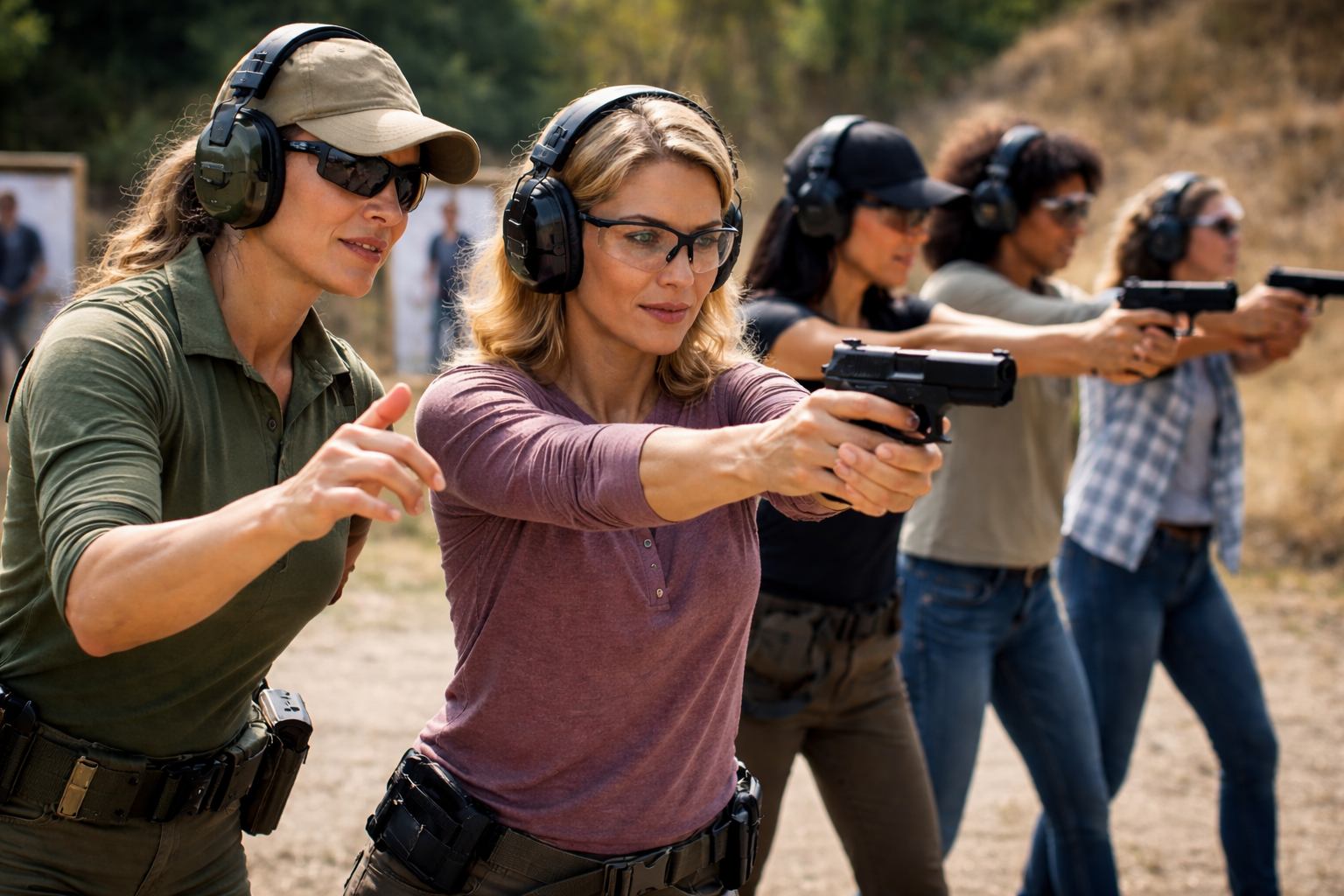
A qualified firearms instructor for women understands that her job is to transfer skill, not impress you. That means:
→ Breaking down each step before you do it
→ Explaining why, not just how
→ Watching your form and correcting it in real time
→ Checking in on your comfort level — without being patronizing
→ Adjusting the pace to your learning speed, not the class average
If the instructor treats the range like a stage and you like the audience, leave. You're not there to clap. You're there to learn how to save your own life.
2. They Have Real Certifications — Not Just Opinions
Owning guns doesn't make someone a firearms instructor. Shooting well doesn't make someone a teacher. And "my uncle taught me" is not a credential.
When you're choosing a concealed carry instructor for women, look for recognized certifications from organizations like:
NRA Certified Instructor — The baseline. Most states recognize it. But a basic pistol cert alone is limited — look for instructors with multiple discipline certifications.
USCCA Certified Instructor — Focused specifically on concealed carry and home defense. The curriculum is built around real-world self-defense scenarios, not just marksmanship.
State-Specific Certifications — Many states require additional licensing to teach concealed carry courses. Make sure your instructor meets your state's requirements.
Continuing Education — The best instructors are perpetual students. Ask when they last took a training course themselves. If they can't remember, that's a problem.
A good rule of thumb: if an instructor gets defensive when you ask about their credentials, they probably don't have many worth discussing.
3. They Understand That Women's Bodies Are Different — And Train Accordingly
This is where most firearms training for women falls apart.
A one-size-fits-all instructor will hand you the same full-size 9mm he gives every student and tell you to "grip it tighter" when you can barely reach the trigger. He'll demonstrate a draw stroke from a belt holster while you're standing there in a wrap dress wondering where exactly you're supposed to put this thing.
A qualified instructor for women accounts for:
→ Hand size and grip strength — and knows which firearms accommodate smaller hands
→ Slide manipulation — teaching techniques that use leverage, not brute force
→ Concealment challenges — because women's clothing is nothing like men's clothing
→ Body mechanics — stance, draw, and recoil management adapted for a woman's center of gravity
→ Real-world scenarios — parking lots with kids, jogging alone, home invasion while your partner is traveling
If an instructor has never thought about how a woman draws from concealment in leggings, they haven't thought about training women at all.
4. Safety Is Non-Negotiable — Not an Afterthought
This should go without saying, but we're going to say it anyway because too many women have told us stories that would make your blood pressure spike.
A legitimate firearms instructor — for women or anyone — enforces the four universal safety rules every single time:
1. Treat every firearm as if it's loaded.
2. Never point the muzzle at anything you're not willing to destroy.
3. Keep your finger off the trigger until you're ready to fire.
4. Know your target and what's beyond it.
If the instructor doesn't cover these before you ever touch a gun — or worse, doesn't correct unsafe behavior from other students — you are in the wrong room. Walk out. No refund is worth your safety.
5. They Create Space for Questions — Without Making You Feel Stupid
Here's what we hear from women all the time: "I was afraid to ask a question because I didn't want to look dumb."
That fear doesn't come from nowhere. It comes from instructors who sigh when you ask something basic. Who use jargon they never bother to explain. Who look at their watch when you need something repeated.
The right women's shooting class creates an environment where no question is too basic, no pace is too slow, and no woman walks away confused about something she was too embarrassed to ask.
"I was terrified about guns before WGOAA... no one helped you get over that fear. Here, that's what everyone does."
— WGOAA Member
A great instructor makes you feel smarter after every session — not smaller.
6. They Don't Just Hand You a Gun and Say "Here, Try This"
If the first thing an instructor does is put a loaded firearm in your hands without walking you through how it operates, how to hold it, how to load it, and how to safely clear it — you're not in a training class. You're in a liability waiting to happen.
Proper women's firearms training follows a progression:
Classroom first. Safety rules, firearm anatomy, how the action works, loading/unloading, and what to expect on the range.
Dry fire second. Practice grip, stance, sight alignment, and trigger press with an unloaded firearm before a single round is fired.
Live fire third. Controlled, supervised, with real-time feedback on every shot.
Debrief last. What went well, what to practice, and a clear next step for continued training.
If your instructor skips straight to live fire, they skipped the foundation. And foundations matter when you're learning to handle a deadly weapon.
7. They Respect Your Pace — Not Their Schedule
A women-only firearms class is not a boot camp. You're not there to be broken down and rebuilt. You're there to build skills, confidence, and comfort with a tool that could save your life.
The best instructors understand that women often come to the range carrying invisible weight — anxiety about firearms, fear of judgment, past trauma, the exhaustion of being the only woman in a male-dominated space. A great instructor meets you where you are, not where they think you should be.
Ask yourself after a session: Did I feel rushed, or did I feel respected? The answer tells you everything.
🚩 Red Flags: When to Walk Away from a Firearms Instructor
Not every bad instructor is obvious. Some red flags are subtle. But they all lead to the same place: bad training, wasted money, and a woman who stops carrying because she never got the foundation she deserved.
❌ They dismiss your questions or make you feel stupid for asking
❌ They recommend a gun without asking about your hand size, body type, or lifestyle
❌ They skip the classroom and go straight to live fire
❌ They don't enforce safety rules — or break them themselves
❌ They refuse to share credentials when asked
❌ They use a one-size-fits-all curriculum with no adaptation for women
❌ They use intimidation or yelling as a "teaching technique"
❌ They make you feel like an inconvenience instead of a student
You deserve better. And better exists.
Questions to Ask Before You Book a Firearms Class
Don't be shy about interviewing your instructor before you hand over your credit card. A professional won't mind. A fraud will.
Ask these before booking:
✦ "What certifications do you hold, and when did you last recertify?"
✦ "Have you trained women specifically? How do you adapt your curriculum?"
✦ "What's the student-to-instructor ratio?"
✦ "Do you provide firearms for the class, or do I need to bring my own?"
✦ "What does the class cover beyond just shooting? Situational awareness? Legal use of force? Concealment?"
✦ "Can I observe a class before committing?"
✦ "Do you offer women-only classes or sessions?"
The answers will tell you if this is someone who takes women's firearms training seriously — or someone who just added "women welcome" to their website to fill seats.
Why Women-Only Firearms Training Changes Everything
There's a reason women-only firearms training exists — and it's not because women can't handle co-ed classes. It's because the learning environment changes completely when the room is full of women who get it.
No one's watching to see if you "mess up." No one's mansplaining your grip. No one's making you feel like you need to prove you belong there.
In a women-only environment, you can ask the questions you'd never ask in a mixed class. You can admit you're nervous without being judged. You can learn at your pace without the silent pressure of keeping up with someone who's been shooting for twenty years.
That's not weakness. That's the most effective learning environment for most women — and the research supports it. Women respond better to instructors who are relatable, patient, and create a judgment-free space. That's not our opinion. That's what thousands of women have told us after years of teaching them.
Done Searching for the Right Instructor?
WGOAA's Armed Female Academy was built by women, for women — with certified female instructors who understand exactly what you need.
Explore the Armed Female Academy →
Does My Firearms Instructor Need to Be a Woman?
No. A female firearms instructor isn't automatically better than a male one. Gender doesn't grant competence.
But here's what does matter: does the instructor — male or female — understand the unique challenges women face? Do they know how concealment works on a woman's body? Can they recommend holsters that actually fit your wardrobe? Do they teach self-defense scenarios relevant to your life — not just his?
Some of the best male instructors we've worked with are outstanding with women because they took the time to learn what makes training women different. And some female instructors are terrible because they just replicate the same male-centered curriculum they were taught.
The gender of the instructor matters less than the quality of the instruction. But if you have the option of a women-only class with a qualified female instructor? That's the gold standard.
The Bottom Line
Your first firearms instructor will shape how you feel about guns for years. Maybe forever. A bad experience doesn't just waste a Saturday — it can make you put your gun back in the drawer and never touch it again.
And that's exactly what we're trying to prevent.
Don't settle for an instructor who treats you like an afterthought. Don't let someone who's never thought about women's training convince you they're qualified to teach it. And don't let one bad class stop you from learning the skills that could save your life.
You deserve an instructor who sees you, respects you, and knows how to train you. Not as a man-lite. As a woman who's ready to own her safety.
Ready to Train with Women Who Get It?
Join the only national firearms training community designed exclusively by women, for women. Monthly Tactical Talks. Certified female instructors. A sisterhood that refuses to let you do this alone.
Starting at $99/year — Cancel anytime
Frequently Asked Questions
How do I find a firearms instructor for women near me?
Start with the WGOAA directory at wgoaa.org/directory to find vetted, women-friendly instructors and ranges in your area. You can also check the NRA and USCCA instructor locators, but be sure to verify they have specific experience training women before booking.
What certifications should a firearms instructor have?
At minimum, look for NRA Certified Instructor or USCCA Certified Instructor credentials. Ideally, they'll have multiple certifications, ongoing continuing education, first aid training, and state-specific qualifications for your area. An instructor who only holds a basic pistol certification may be limited in what they can teach.
Is a women-only firearms class better than a co-ed class?
For most women — especially beginners — yes. Women-only classes create a judgment-free learning environment where you can ask questions freely, learn at your own pace, and train alongside women who understand your specific challenges. That said, co-ed classes with a great instructor can also be highly effective.
How much should a firearms training class cost?
Basic pistol classes typically run $75–$200. Concealed carry courses range from $100–$300 depending on your state and what's included. Private one-on-one instruction is usually $75–$150 per hour. Be wary of classes that are significantly cheaper — low cost often means large class sizes and minimal individual attention.
Can I try a class before committing?
Many instructors will let you observe a portion of a class before you sign up. This is a great way to evaluate their teaching style, the environment, and whether you'd feel comfortable. If an instructor won't allow a brief observation, consider that a yellow flag.
What should I bring to my first firearms class?
Most beginner classes provide everything, but confirm with your instructor. Generally bring: eye protection, ear protection (electronic muffs are best), closed-toe shoes, a high-collared shirt (to prevent hot brass from going down your neckline), water, and a positive attitude. Leave the open-toed shoes and low-cut tops at home.