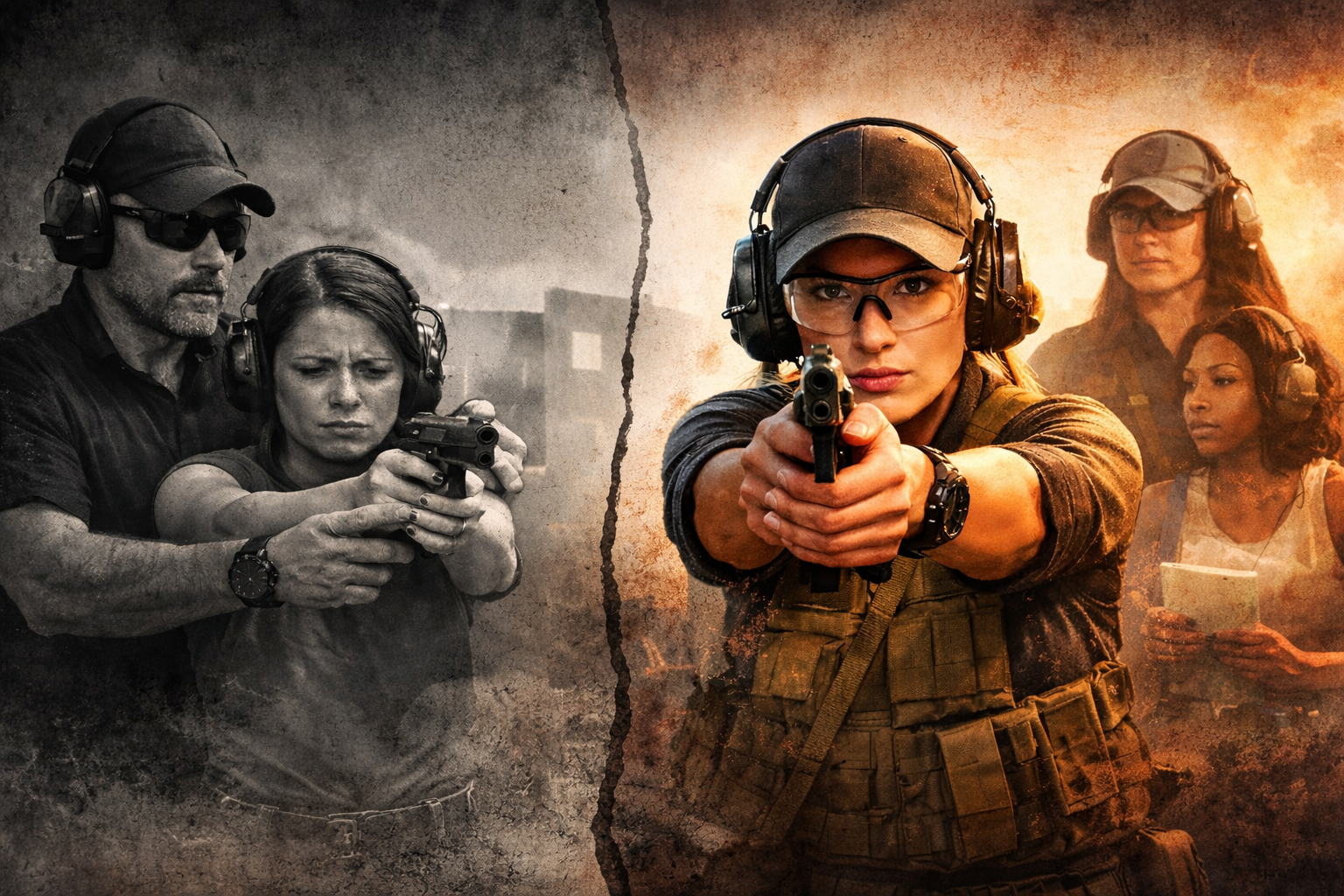
The firearms industry has spent decades teaching women how to shoot like men. That's not training. That's negligence.
Walk into most firearms training courses in America and you'll notice something immediately: the curriculum was built by men, tested on men, and delivered by men — with the quiet assumption that women will simply adapt.
They hand you a gun that doesn't fit your hand. They teach you a draw stroke designed for a man's waistband. They run drills calibrated for upper body strength you don't have. And when you struggle — because the system was never designed for you — they tell you to "just practice more."
That's not firearms training for women. That's firearms training for men with women in the room.
And it's one of the biggest reasons women freeze under stress when it matters most — not because they're incapable, but because they were never properly trained in the first place.
The 92% Problem Nobody Talks About
Only 8% of firearms instructors in America are women.
Think about what that means. Ninety-two percent of the people teaching women to shoot, carry, and defend themselves have never lived in a woman's body. They've never worn a dress and tried to draw from concealment. They've never had to think about on-body vs. off-body carry while managing a diaper bag and a toddler. They've never felt the specific kind of fear that comes from being physically smaller than every threat in the room.
The NRA has 125,000 certified instructors. The USCCA runs a national network of training courses. A Girl & A Gun has chapters across the country. And yet the vast majority of these programs treat women's training as a footnote — a "ladies night" version of the same male-centric curriculum.
The Women Gun Owners Association of America was built to fix that. Not to add a pink ribbon to a man's program, but to design firearms education from the ground up — by women, for women, through women.
Here's what that actually looks like in an instructor.
Your Body Is Not His Body: The Biomechanical Reality
Firearms training that ignores anatomy isn't training — it's guesswork.
Women's hands are, on average, significantly smaller than men's. Grip strength differs. Arm length differs. The way recoil transfers through a smaller frame differs. These aren't minor details. They're foundational to everything from trigger reach to muzzle control.
When an instructor tells a woman to "grip harder," he's applying a male solution to a female problem. The answer isn't more force — it's a different technique. Proper hand placement. A grip angle that accounts for shorter fingers. Recoil management that uses skeletal structure instead of raw muscle.
This is why so many women end up with guns that don't fit them. They're handed a compact 9mm because it's "small enough for a woman" — without any discussion of trigger reach, sight radius, or how finding the right firearm for a smaller frame actually works.
The gun doesn't need to be smaller. The training needs to be smarter.
The Carry Problem Men Will Never Understand
A man puts a holster on his belt. He's done.
A woman? She's navigating clothing that wasn't designed for concealment. She's thinking about waistlines that sit differently, fabrics that print, and the reality that most women's fashion doesn't include a rigid belt line.
This is why concealed carry options for women require their own curriculum — not a sidebar in a standard CCW class. Belly bands, thigh holsters, compression garments, appendix carry with different body proportions — these aren't niche topics. They're the daily reality for every woman who carries.
And it goes deeper than hardware. The draw stroke from a belly band is mechanically different from a belt holster. The presentation from a crossbody bag follows a different sequence entirely. If your training never covered these specific motions, your muscle memory is built on a foundation that doesn't match your actual carry setup.
That's not a training gap. That's a survival gap.
Women Process Threat Differently — and That Changes Everything
Men are generally trained to identify and engage threats. Locate. Assess. Act.
Women are navigating a different threat landscape. Women are more likely to face threats from people they know. They're more likely to encounter situations that escalate gradually rather than explode suddenly. And they're more likely to second-guess their own instincts — not because those instincts are wrong, but because they've been socialized to be polite instead of prepared.
This is why situational awareness training for women can't just be Cooper's Color Codes on a PowerPoint slide. It has to address the specific ways women are conditioned to override their own danger signals.
There are pre-incident indicators that women routinely miss — not because they aren't paying attention, but because they've been taught to explain away discomfort rather than act on it.
Real firearms training for women teaches you to trust the alarm before you can name the threat. It teaches you that being "rude" to a stranger who closes distance is not an overreaction — it's a trained response. It builds the mental framework where confidence replaces hesitation before a situation ever becomes physical.
The NRA doesn't teach this. The USCCA mentions it. WGOAA builds the entire curriculum around it.
The "Just Buy a .380" Problem
Walk into a gun store as a woman and you'll hear some version of this: "You want something small and light. A .380 would be perfect for you."
That advice isn't just lazy. It's potentially dangerous.
A lightweight .380 snaps harder in a small hand than a properly fitted 9mm. The reduced sight radius makes accuracy harder, not easier. And the lower energy means less stopping power when it counts — the exact opposite of what a woman facing a physically larger attacker needs.
The right gun for a woman isn't determined by her gender. It's determined by her hand size, grip strength, intended use, carry position, and training level. Those are individual variables — and they require individual instruction.
This is what separates women-designed firearms training from the industry standard. It starts with the woman. Not the gun. Not the caliber chart. Not what the guy behind the counter thinks is "cute enough" for her to carry.
What Real Firearms Training for Women Looks Like
It's not a ladies' night. It's not a "pink and shrink" version of a tactical course. It's not a room full of women being taught by a man who thinks speaking softer makes it women's training.
Real women's firearms training means the curriculum was designed around how women carry, how women fight, and how women think under pressure.
It means instructors who understand that a woman's first defensive tool is owning her space — voice, posture, and presence — before she ever touches a firearm.
It means addressing the emotional reality that motherhood and preparedness aren't at odds — they're the same instinct.
It means building training around the truth that more women are choosing concealed carry every year — and those women deserve education that meets them where they are, not where a male instructor assumes they should be.
That's what the Armed Female Academy was built to deliver. Structured, women-designed firearms education you can access from your living room — because the woman juggling kids, a career, and a household doesn't have time to drive 45 minutes to a range for training that wasn't built for her anyway.
The Industry Won't Fix This. Women Will.
The NRA has programs for women. The USCCA has women's courses. These organizations have scale and resources that dwarf anything a single women-led organization can match — on paper.
But scale without specificity is noise.
What those organizations offer women is access. What WGOAA offers is understanding. The difference is everything.
There's a reason the modern armed woman isn't looking for another "ladies' shooting night" at the local range. She's looking for education designed by someone who has lived her reality. She wants to learn from women who have navigated the same industry bias, the same condescending gun counter experiences, and the same myths about women and guns that have kept women undertrained for decades.
She's not looking for permission to participate in a man's world.
She's building her own.